

Rear-curtain Abstract Bird Images
Jim Taylor, 13/3/2020
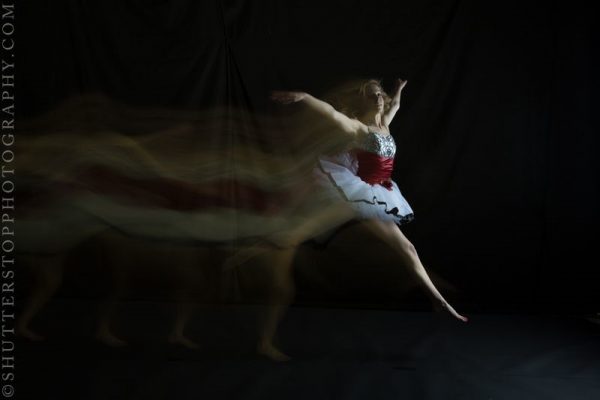
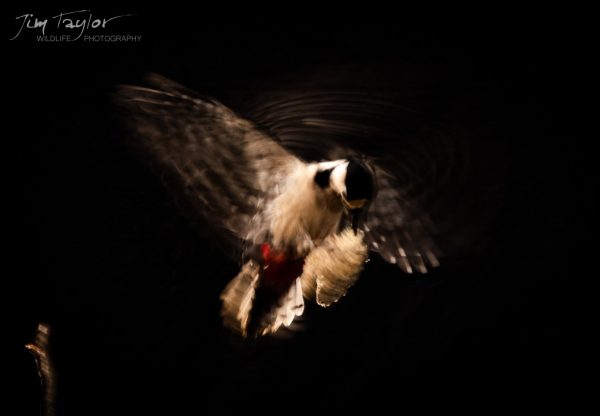
As an amateur wildlife photographer who is keen to learn and develop, earlier this week I decided to have a go at taking what might be described as abstract bird shots on a dark black background, showing blurred movement but then with a ‘frozen movement punch’, by using slow shutter speed & flash on rear-curtain. The sort of photos we’ve all seen of ballet dancers on a dark stage.
Anyway, the start point here was to create a very-matt black background which I did by buying some garden matting & then painting it with black chalkboard paint to enable me to create a 7-foot square screen.
But then I decided, the next raw material in this little experiment, was lots of compliant birds that would happily fly in front of a pretty big black screen …. Not the sort I have in my back garden!
So I contacted John at Millers Wood…. In case you’ve never been, John is a talented wildlife photographer and his Millers Wood site has several great hides and diverse woodland birds galore.
And this Thursday, I got together with John at Millers Wood. It happened to be a bright sunny, but windy day …. Exactly the wrong conditions it so happened, for the day ahead.
Because of the wind, we set up at the most protected of the hides and fixed the big black screen, a couple of feet behind where we wanted the birds, and to a huge log to try and weigh-it-down enough not to blow over.
Then John set the stage, to attract the birds. On the grassy bit of lawn, constructed at chest-height in front of the hide, John brought in a little log to act as a staging post for the bigger birds like the woodpeckers. And at 45 degrees to this log, and at about 3 feet up from the lawn, John suspended some bird food. The intention of this was, that photography would concentrate on the move up from the log or lawn, as the birds flew up to hover next to and feed off bird food.
Whilst John was doing all this, I set up my camera & flashes in the hide. Choosing a 300mm f2.8 lens – which is generally a great lens for Johns’ hides – I set up my full-frame Nikon camera & lens on a gimbal head, with a Nikon DC-MC2 remote release cable.
The images rely on a slow shutter – of around 1/20th of a second – and a relatively dark ‘basic’ image. To achieve this on a bright day, I selected a Manual setting, dropped the ISO as low as possible, put the aperture to f18, and selected a -5.0 under-exposure compensation value.
In terms of the flash, I set the camera to rear-curtain; and then, set up for 2 off-camera flashes, to enable me to combine flash from just below / behind the birds, as well as from the front. I did this by using a Camtraption transmitter on the camera, triggering Camtraption receivers connected to the 2 flash guns I was using.
And then, after a cup of tea with John, I kicked off the day’s photography.
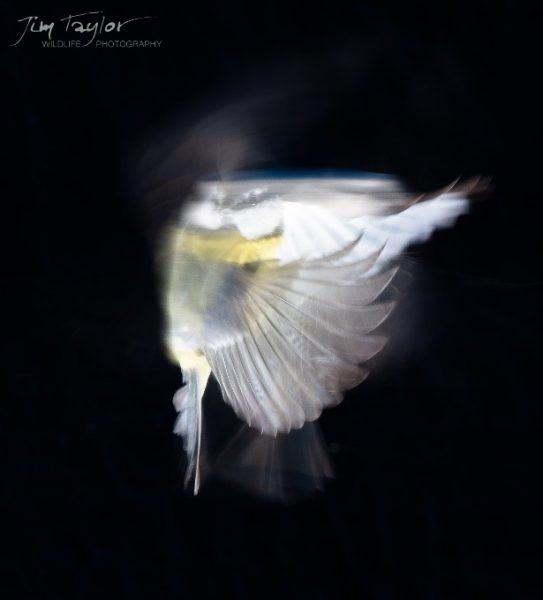
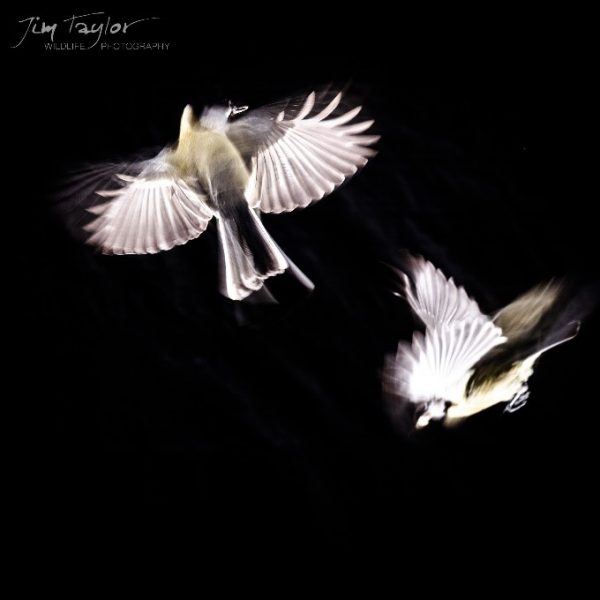
As the day progressed, I trialed different shutter speeds, starting with 1/15th (most blur) and then 1/20th but then finishing the day on 1/30th
But I found the flash exposure had a stronger effect on the end image and using both flash guns on Manual & with different strengths, I found by trial and error, that it was important to get enough flash ‘punch’ from close behind & below, to create a distinct ‘core’ to the image; otherwise, the danger was, the birds only created wispy movement trails!
The sunlight proved the chief enemy across the day – there was just too much of it! Furthermore, particularly in the morning, it was falling on the big black screen such that both a ‘sheen’ and the backdrop detail was showing – not helped by the relatively large depth of field I had from the f18 aperture.
By lunchtime, the sun had shifted & the front side of my black screen was in shadow – much better! I also physically pulled it back a bit further away from the birds, to help ensure less backdrop detail being picked up in the pictures.
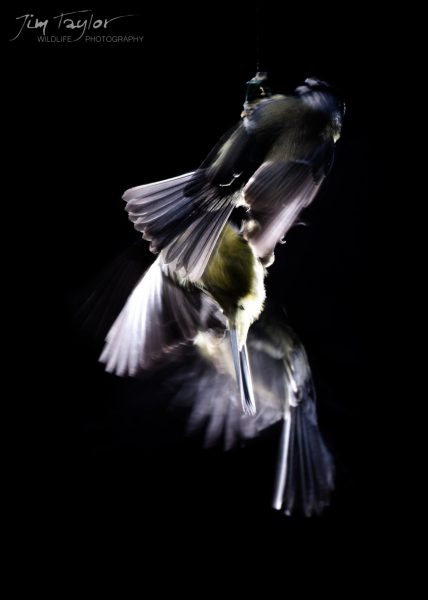
And by early afternoon I was getting lots of good images…. That is if you like the abstract sort of thing. Here are a few that I like a lot …
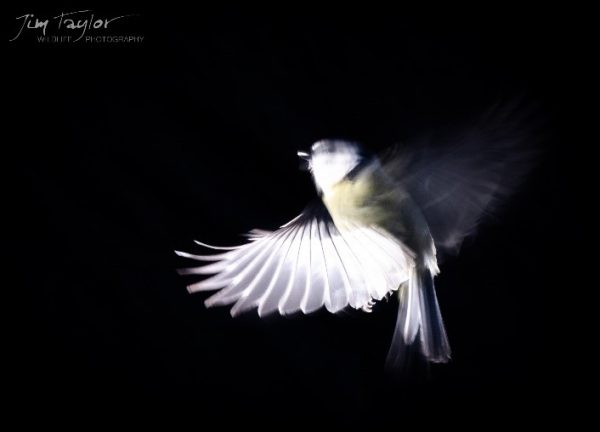
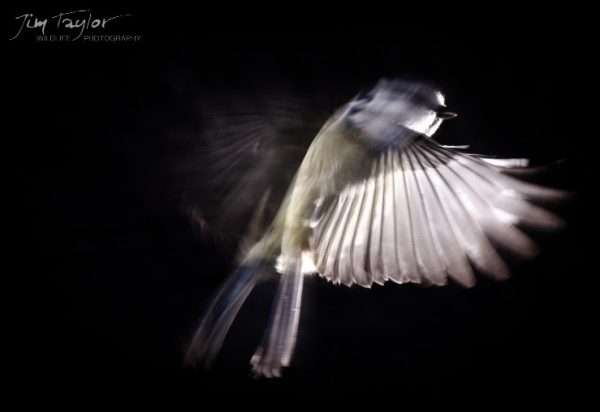
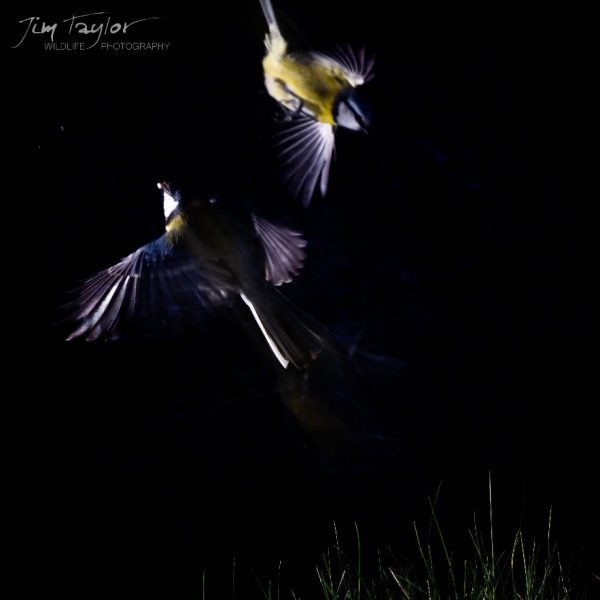
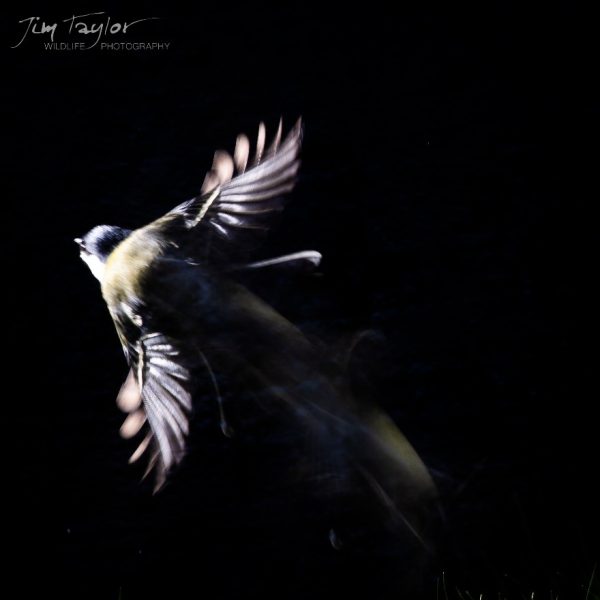
I thoroughly enjoyed the day and the learning process. But there are several things I could have done better:
First – and alien to our general thinking as wildlife photographers – lookout for a dark, low light day, which will mean you can use less depth of field with less black backdrop detail being picked up, because you can get away with an f8 or f11 aperture, for example
Second, put a disproportionate effort on getting the Greater-Spotted Woodpeckers, moving on the image – simply because they’re such colorful birds & the red stands out so well in the dark images. These birds aren’t big fans of ‘hovering by the bird food’ so, in retrospect, I wish I’d engineered the stage slightly so as to give them a prop on both left and right to move across.
Third, I’d have used a 100-300mm zoom to allow me to go a bit wider to accommodate bigger birds like Woodpeckers or Jays; with many of my shots of these birds, a wing was missing in the resulting picture.
Please get in touch with John if you’d like to spend the day trying this. We’ve kept the ‘big black screen’ at the site; and I’d be happy to run a day’s workshop – price for 1 person £150 including hide rental; price for 2 or more, £125 per person including hide rental.
https://www.facebook.com/Jim-Taylor-Photography-100135891398811/
Leave a reply